Pillow Selection
Choosing Pillow Loft for Your Sleeping Position
A pillow’s height can change the way your head, neck, and shoulders settle overnight. The best loft is not a universal measurement: it depends on how you sleep, how much your pillow compresses, the feel of your mattress, and what keeps your body comfortably aligned.
What pillow loft means
Pillow loft is the pillow’s height as it supports your head. In practical terms, it is the space the pillow fills between your head and the mattress—not simply the height the pillow appears to have on a store shelf. A lofty pillow may flatten substantially under pressure, while a denser pillow may retain more of its apparent height when you lie down.
That distinction matters because the goal is not to lift the head as high as possible. It is to find a position in which the head and neck feel supported without being pushed sharply upward, allowed to fall too far toward the mattress, or twisted to one side. A pillow that looks full before bedtime may compress into a very different shape by morning.
Loft is one part of pillow selection, alongside firmness, fill, construction, and shell fabric. The same nominal height can feel different in a soft down pillow, a resilient foam pillow, or a springy synthetic fill. Even within a single pillow, the center and edges may behave differently. Consider the shape that remains under your head, not just the pillow’s uncompressed profile.
There is no single ideal pillow height for every person who sleeps on the same side, back, or stomach. Body proportions, shoulder width, mattress cushioning, and personal comfort all play a role. Sleeping position offers a useful starting point; careful observation helps refine the choice.
Why alignment and comfort belong together
A pillow should make it easier to rest in a comfortable, natural position. If it is too high, the head may be angled upward or the neck may feel crowded. If it is too low, the head may sink toward the mattress, leaving the neck without the support it seems to need. Either mismatch can make it harder to settle in one position.
Comfort is not a clinical measurement, and a pillow cannot diagnose or treat neck pain. But repeated discomfort is useful information. If you wake with stiffness, notice that you keep folding or bunching your pillow, or routinely move it aside, its loft or feel may not suit you. Consider the pattern over several nights rather than judging from a few minutes in a showroom.
Alignment is also not a matter of forcing the body into a rigid pose. People shift as they sleep, and a well-chosen pillow should feel supportive without demanding stillness. The practical test is whether your head feels settled, your neck is not strained by the pillow’s height, and you can remain comfortable in your usual position.
Side sleepers: account for the shoulder gap
Side sleeping often calls for more loft than back or stomach sleeping because the pillow must fill the space between the side of the head and the mattress. Shoulder width influences that space, but mattress cushioning matters too. A broad shoulder resting on a yielding mattress may sink more deeply than the same shoulder on a firm surface. The result is a smaller gap for the pillow to fill.
A side sleeper can begin by lying on the usual side and noticing whether the head feels level or tilted. If the pillow pushes the head away from the mattress, it may be too high or too resistant to compression. If the head seems to drop toward the mattress, the pillow may be too low, too soft, or too compressed. Those impressions are more useful than selecting a pillow based on height alone.
Fill construction changes the experience. A supportive, resilient fill may preserve a clear cushion beneath the head; a soft fill may mold closely but compress further under weight. A gusseted edge can help a pillow maintain a more consistent profile, although it does not guarantee the correct loft for every sleeper. The important question is how the pillow behaves once you are actually lying on it.
Some side sleepers change sides during the night. If so, consider whether the pillow remains comfortable as you turn and whether it can be repositioned easily. A pillow that is agreeable on one side but cumbersome to adjust may be less practical than its initial feel suggests.
Back sleepers: look for moderate, stable support
Back sleepers generally need a pillow that supports the head without lifting it excessively. A very lofty pillow may angle the head forward; a low or highly compressible pillow may let it fall back toward the mattress. The useful range depends on the sleeper’s build, the bed’s surface, and the pillow’s response to weight.
Try lying in your usual position for several minutes. Notice whether the pillow feels as though it is filling the space comfortably or pushing the chin toward the chest. If it feels too tall, test a lower pillow or a fill that compresses more. If the head seems to sink too far, consider a more supportive construction or a loft that remains steadier under pressure.
Back sleepers may also notice the difference between a pillow that supports the center and one that feels uniformly tall from edge to edge. Shape and placement can matter as much as the advertised height. A pillow should not require constant tugging or folding to achieve a comfortable position, although some adjustability may be useful for people whose preferences vary.
Stomach sleepers: avoid unnecessary height
Stomach sleeping places the head turned to one side, so a high pillow can add more angle than feels comfortable. Many stomach sleepers prefer a low-loft pillow or a soft fill that compresses substantially. The aim is to avoid creating extra lift beneath the head while still having a surface that feels pleasant.
Pay attention to what happens after the pillow has been under your head for a while. If you flatten it with your hands before settling in, or push it away once you fall asleep, those habits may indicate that its loft is more than you want. A pillow that appears thin when uncompressed may still feel too high if its fill resists pressure.
Some people combine positions, beginning on the stomach and later turning onto a side. A very low pillow can suit the first position but feel inadequate after a turn. In that case, prioritize the position in which you spend the most time, and look for a pillow that can be adjusted or reshaped without losing its basic support.
The mattress changes the equation
Pillow loft is often discussed as though the pillow works alone. It does not. A mattress changes how deeply the shoulder, hip, and upper body settle, which in turn changes the distance between the head and the bed. On a cushioned mattress, the body may sink farther, reducing the space the pillow must fill. On a firmer surface, that space may remain larger.
This is why a pillow that feels right in a shop may behave differently at home. If possible, assess it on the mattress you actually use, in your normal sleeping position. When changing both mattress and pillow, evaluate the new combination rather than assuming a familiar pillow will feel identical on a different surface.
Changes in mattress feel can also affect people who sleep in more than one position. A softer surface may make a formerly comfortable side-sleeping pillow feel too tall; a firmer one may make the same pillow seem less substantial. Reassess loft after a significant change to the bed rather than relying on an old impression.
Fill, firmness, and compression
Loft is a starting dimension; compression determines how much of that height remains in use. Down and other soft fills can be shaped and may compress under the head. Foam and firmer fills can offer a more consistent platform, depending on their density and construction. These are broad tendencies, not guarantees: pillows vary, and individual products can behave differently.
Fill power is a measure associated with the volume a given amount of down occupies under specified conditions. It can help describe the character of a down fill, but it is not a direct measure of the height a sleeper will experience. Shell fabric, fill weight, chamber design, and the sleeper’s pressure all influence how the pillow feels in practice.
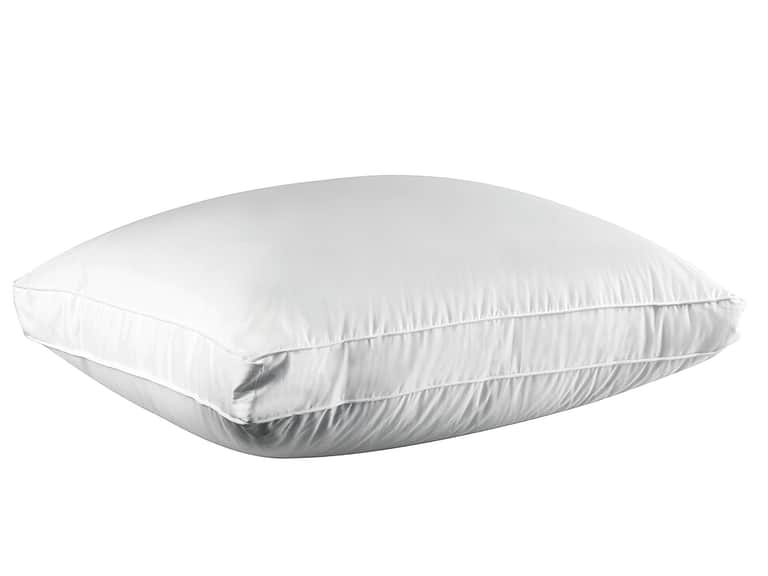
The Clean Bedroom Manhattan Down-Filled Pillow is described as medium-firm with a high loft, with 850 fill power large-cluster Hungarian goose down and a two-inch gusset. Its specifications make it a relevant option for shoppers considering a lofty down pillow, particularly those who want to compare a fuller profile with a softer, more compressible feel. The stated fill and construction do not determine whether it is right for a particular person; the deciding factor remains how its loft feels in the sleeper’s usual position.
Its listed sizes carry different fill weights: 16 ounces for Standard, 18 ounces for Queen, and 20 ounces for King. Size and fill weight help describe the product, but they should not be treated as a personalized support recommendation. A larger pillow is not necessarily a better match for a specific body or sleep position.
A practical way to test pillow loft
When comparing pillows, use a simple, repeatable process. Test each one in the position you actually use, on a surface similar to your bed if possible. Give the fill time to settle under your head, and notice whether the pillow keeps its shape or compresses substantially. Changing pillows every few seconds can make small differences difficult to interpret.
- Start with your main sleep position. Side, back, and stomach sleeping create different support needs.
- Notice the angle of your head. Ask whether the pillow seems to push it up, let it drop, or support it comfortably.
- Wait for compression. A pillow’s useful loft is the height it maintains under pressure, not its display height.
- Consider the mattress. Shoulder and upper-body sink can change the space the pillow needs to fill.
- Try moving naturally. If you change positions, check whether the pillow remains comfortable after a turn.
- Observe your routine. Frequent folding, bunching, or pushing the pillow away can point to a mismatch.
If a pillow is adjustable, change the fill gradually rather than making a dramatic alteration at once. Keep track of what you changed and how it felt over several nights. This makes it easier to separate a genuine improvement from the uncertainty that comes with trying something new.
Common pillow-loft misconceptions
“Higher means more supportive.” Height is not the same as support. A high pillow that collapses may feel less supportive than a lower one that holds its shape; a firm, tall pillow may lift the head more than a sleeper wants.
“My sleeping position determines the answer.” Position is a useful guide, but it is not the whole calculation. Mattress feel, shoulder width, head size, fill behavior, and personal preference all influence the result.
“A pillow should feel perfect immediately.” An initial test is helpful, but the pillow may settle differently over time. If a retailer offers a trial period, understand its conditions and use the pillow consistently enough to make a considered judgment.
“One pillow works for everyone in the household.” People differ in build, position, mattress, and preferred feel. A pillow that suits one sleeper may be too high, too low, too firm, or too soft for another.
“Loft alone explains every morning ache.” Discomfort can have many causes. A pillow mismatch may be worth examining, but persistent or severe pain calls for advice from a qualified health professional rather than a promise from bedding alone.
Care and shape retention
A pillow’s loft can change with use, and appropriate care helps preserve its intended feel. Follow the care label rather than assuming that every down or synthetic pillow can be washed in the same way. Drying instructions matter: residual moisture can affect freshness, while excessive heat or rough handling may harm some materials.
A washable pillow protector can help shield the pillow from everyday moisture and soil. Regularly airing and gently fluffing a pillow, when recommended for its fill, may help it recover its shape. Avoid using a damaged or lumpy pillow as though it were still providing its original profile; an uneven fill can make support inconsistent.
Inspect the pillow periodically for persistent flattening, clumping, damaged seams, or a loss of comfort. How long a pillow remains useful depends on its materials, care, frequency of use, and personal standards. Replace it when it no longer provides a clean, comfortable, and reasonably consistent surface.
A decision grounded in your own sleep
Choosing pillow loft is less about finding a number than finding a fit. Side sleepers often begin with enough height to fill the shoulder-to-head gap; back sleepers generally look for moderate support that does not push the head forward; stomach sleepers commonly favor a lower, more compressible profile. Each is a starting point, not a rule.
Bring the mattress into the decision. Consider how the fill compresses, whether the pillow keeps its shape, and how it feels after you have settled into your usual position. Above all, use repeated comfort—not marketing language or uncompressed height—as your guide.
A well-matched pillow should feel like a quiet part of the bed: present enough to support the head and neck, but not so prominent that you spend the night negotiating with it. Begin with your sleeping position, test the pillow on your own terms, and let the experience of several nights make the final call.