Pillow construction & sleep comfort
The Clean Bedroom’s 2-Inch Pillow Gusset: How Edge Construction Affects Loft
A pillow’s profile is shaped not only by what goes inside it, but by how its edges are built. A gusset creates a defined sidewall that can help a pillow hold a fuller shape. On The Clean Bedroom’s Manhattan Down-Filled Pillow, that sidewall measures two inches. Here’s what the detail means—and what it cannot tell you on its own.
The small seam with a larger job
When shoppers compare pillows, the conversation often starts with fill: down, feather, latex, foam, or a synthetic alternative. Then comes firmness, perhaps followed by the cover fabric and the care label. Edge construction tends to arrive later, if it arrives at all. Yet the way a pillow is sewn can influence the shape it presents on a bed and the way its filling is distributed inside.
A gusset is a strip of fabric that joins the top and bottom panels around a pillow’s perimeter. Rather than tapering directly from one broad face to the other, the pillow has a sidewall. That panel gives the edge measurable depth—in this case, two inches—and establishes a more box-like outline. It is a construction feature, not a type of fill, and it does not independently determine whether a pillow is soft, firm, supportive, or suitable for a particular sleeper.
The distinction matters because “loft” is often used as shorthand for several things at once. It can mean a pillow’s visible height before use, the height it retains under a head, or the general sense of fullness it gives a bed. A gusset can help preserve a tall, defined profile by creating space at the perimeter for filling. But the actual feel also depends on fill quantity, fill behavior, the pillow’s dimensions, and how much pressure the sleeper applies.
In other words, a gusset is part of the architecture. The materials and the person using the pillow determine how that architecture performs night after night.
What a two-inch gusset changes
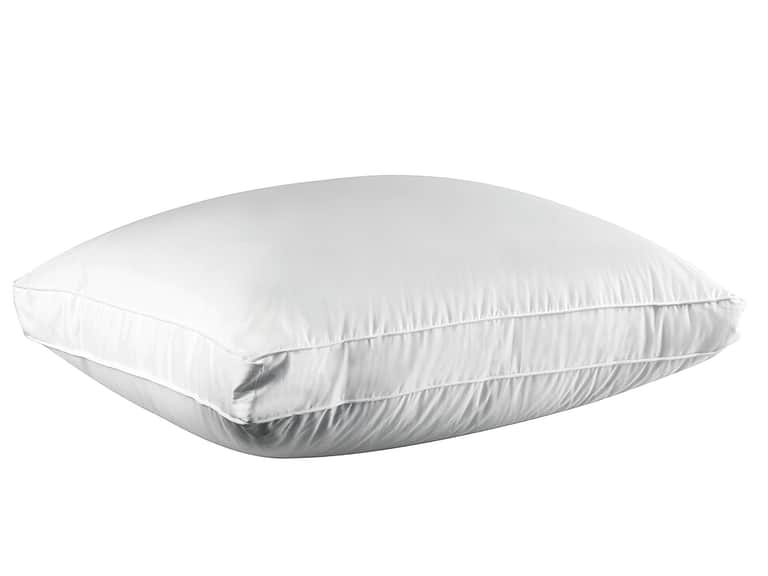
The Clean Bedroom’s Manhattan Down-Filled Pillow is described as a medium-firm, high-loft pillow with a two-inch gusset and double-stitched piping. The gusset forms the sidewall; the piping finishes and reinforces the seam where the fabric panels meet. Together, those details give the pillow a more structured perimeter than a conventional pillow whose upper and lower panels are sewn directly together around the edge.
That sidewall can provide room for the fill to occupy the pillow’s full depth. It may help the pillow look fuller and make its height more consistent from the center toward the perimeter. A shaped edge can also make the pillow’s outline easier to maintain when it is arranged on a bed. These are useful design intentions, not guarantees of a particular height under load. Down compresses when a head rests on it, and the amount of compression varies with fill, body weight, sleeping position, and how the pillow has been fluffed.
Think of the gusset as setting the boundaries of the pillow’s form, rather than acting like a rigid support frame. It does not lock the fill in place or stop the pillow from changing shape. Instead, the sidewall provides a defined volume around the perimeter while the filling responds to movement and pressure. A well-made seam helps keep that construction intact, but it cannot make a soft fill behave like foam or guarantee that every sleeper will experience the same level of support.
For a down pillow, that balance is especially relevant. Down clusters are valued for their lightness and ability to loft after compression, but they are also pliable. The result can feel buoyant and adjustable rather than fixed. A gusseted edge can support the appearance of a higher, more dimensional pillow; the down still supplies the cushioning and determines much of the pillow’s response.
Loft, firmness, and support are not synonyms
It is easy to read “high loft” as a promise of firmness. The two qualities are related in use, but they describe different things. Loft refers to height or fullness. Firmness is the perceived resistance a pillow offers when compressed. Support is a broader question: whether the pillow helps keep the head and neck in a comfortable position for a particular sleeper.
A high-loft pillow can feel soft if its filling compresses readily. A lower-profile pillow can feel firm if the material resists pressure. And a pillow that feels supportive to one person may be too elevated or too yielding for another. A gusset adds construction depth, but the sidewall measurement should not be mistaken for the pillow’s settled height under the head.
That distinction is useful when evaluating product descriptions. “Two-inch gusset” tells you the depth of the perimeter panel, not that the pillow will stand exactly two inches tall in every area or remain at a fixed height overnight. “Medium-firm” and “high loft” provide additional clues, but they are still broad descriptors. Personal fit depends on the relationship between the pillow and the sleeper’s body, mattress, and habitual position.
Side sleepers often need more space filled between the head and mattress than stomach sleepers do, but individual needs vary with shoulder width, mattress softness, and preferred posture. Back sleepers may seek a pillow that supports the natural curve of the neck without pushing the head too far forward. Stomach sleepers commonly prefer a lower profile to reduce excessive neck rotation. These are starting points, not rules. The most important test is whether the pillow feels comfortable and allows a relaxed position without persistent strain.
For that reason, a gusset should be one item on a comparison list—not a shortcut to choosing the right pillow. Consider it alongside fill power, fill weight, dimensions, firmness guidance, and your own experience with pillow height.
Reading the Manhattan pillow’s construction
The Manhattan Down-Filled Pillow brings several construction choices together. The Clean Bedroom describes it as medium-firm with high loft, filled with 850 fill power large-cluster goose down and finished with a two-inch gusset and double-stitched piping. Its cover is described as tightly woven, 330-thread-count cotton. Those details address different parts of the experience: the down contributes loft and cushioning; the shell contains the fill; and the gusset and piping shape and finish the perimeter.
Fill power is a measure of the volume occupied by a given weight of down under standardized testing conditions. It is not a direct rating of firmness, nor does it alone reveal the total amount of filling in a finished pillow. Two pillows with the same fill power may feel different if their fill weights, dimensions, construction, and shell fabrics differ. A useful comparison therefore looks at the complete specification rather than treating one number as a verdict.
The Manhattan pillow is offered in standard, queen, and king sizes. Product specifications list approximate dimensions of 20 by 26 inches for standard, 20 by 30 inches for queen, and 20 by 36 inches for king. Listed fill weights are 16, 18, and 20 ounces, respectively. A larger pillow may suit a larger bed or a particular pillowcase size, but dimensions do not automatically translate into greater support. Fit the pillow to the bed and bedding while keeping personal comfort at the center of the decision.
The brand also states that the down is sourced to the Responsible Down Standard and that the pillow is made in Hungary. These sourcing and manufacturing details are separate from the gusset itself. They may matter to shoppers evaluating provenance, but they do not change the basic function of the sidewall: to give the pillow a defined edge and space for its fill.
For readers comparing the specification with other designs, the product page for The Clean Bedroom Manhattan Down-Filled Pillows is the appropriate place to review the available sizes and current product details.
How to assess a gusseted pillow in real life
Product language can make a pillow sound more decisive than it feels. The practical question is not simply whether a gusset exists, but whether the complete construction suits the way you sleep. A few observations can make an at-home assessment more useful.
- Notice your starting position. Lie down in the position you use most often, with the pillow in its normal case. Avoid judging it only by how it looks fluffed on the bed.
- Pay attention to height under pressure. A pillow’s uncompressed profile is only part of the story. Notice whether it feels too tall, too low, or comfortable once your head has settled.
- Check how the edge behaves. The sidewall should feel like part of the pillow, not an awkward ridge that distracts you. The gusset is a perimeter construction feature; you should not need to position your head on the seam to benefit from it.
- Consider the shell and case together. A tightly woven cotton shell and the pillowcase can affect surface feel and airflow. A close-fitting case may also compress the pillow’s outline, so check that the case size matches the pillow.
- Observe whether the fill redistributes. Down is flexible, and the pillow may need occasional fluffing. See whether it recovers to a shape you find comfortable after use, rather than expecting its profile to remain unchanged.
- Allow for adjustment. A new pillow can feel different from one that has been used and settled. Follow the care instructions and any retailer return policy before deciding whether the fit is right.
These checks are more meaningful than pressing a pillow once in a store or judging its appearance in a photograph. Comfort is experienced over time, and construction details become useful when they can be connected to that experience.
Gusseted versus standard-edge construction
A traditional knife-edge pillow has its top and bottom panels joined around the perimeter, often producing a tapered edge. A gusseted pillow adds a fabric panel between those faces, creating a deeper sidewall. Neither construction is universally better. Each shapes the pillow differently, and the right choice depends on the fill, design goals, and sleeper’s preferences.
A gusset may appeal to someone who wants a visibly fuller outline or a pillow with a more defined perimeter. It can provide more space at the edges for the fill and help the pillow retain a consistent-looking profile. A standard-edge design may suit someone who prefers a simpler, less structured outline. The comparison is about shape and construction—not a ranking of sleep quality.
Other design elements can narrow or widen the difference. Fill type affects how a pillow rebounds, while fill quantity affects how much material is available to occupy its shell. Baffle-box or channel construction, when present, can influence how filling is divided internally. Shell fabric and stitching quality help determine how the pillow contains its fill. The gusset operates within this larger system rather than replacing it.
It is also worth distinguishing a gusset from a decorative border. A visible band around the edge may be purely ornamental, or it may form the actual sidewall. Product specifications and close attention to construction can help clarify which. In the Manhattan pillow’s description, the two-inch gusset is presented as a functional part of the design, finished with double-stitched piping.
Care and shape retention
A gusset does not remove the need for care. Pillows encounter moisture, skin oils, and everyday compression; their materials and seams benefit from attention consistent with the manufacturer’s instructions. The Clean Bedroom recommends using a washable pillow protector to help protect the pillow. A protector adds a practical barrier between the pillow shell and routine use, while the pillowcase remains the regularly changed outer layer.
Follow the care label rather than assuming that every down pillow can be washed in the same way. Washing and drying methods can affect fill, shell, and stitching, and inadequate drying can leave moisture in a down-filled product. If the label permits laundering, follow its directions carefully. Between deeper cleaning, regular airing and gentle fluffing may help restore the pillow’s shape, but avoid aggressive handling that could stress seams or fabric.
Shape retention is not the same as permanent shape. Down clusters can compress and redistribute, and a pillow used night after night will not look exactly as it did when new. The gusset gives the edge a defined structure; it does not prevent normal changes from pressure or use. Keeping a protector on the pillow, using a correctly sized case, and following care guidance can help preserve the materials and construction over time.
What the gusset can—and cannot—promise
The phrase “superior loft” can sound like a simple outcome. In practice, loft is the product of several interacting factors. A gusset can make room for a fuller perimeter and contribute to a more dimensional silhouette. High-quality down can offer light, responsive cushioning. The amount of fill, the dimensions of the pillow, the shell, and the sleeper’s pressure all influence the final result.
What the gusset cannot do is guarantee neck alignment for every body, convert down into a firm support surface, or tell you whether the pillow is the right height for your mattress and sleeping position. It also cannot substitute for transparent information about fill, care, size, and construction. The best buying decision weighs the whole design against your preferences and, where possible, your experience using the pillow.
That is why the two-inch measurement is best understood as a useful specification rather than a verdict. It tells shoppers that the Manhattan pillow has a defined sidewall. Paired with its stated medium-firm feel, high-loft profile, 850 fill power goose down, cotton cover, and double-stitched piping, it gives a fuller picture of the product’s design. The details are most valuable when read together.
A practical checklist for comparing pillow construction
When weighing gusseted pillows against one another—or against standard-edge alternatives—use a compact checklist. It can prevent one appealing feature from eclipsing the rest of the design.
- Construction: Is the gusset an actual sidewall, and what is its stated depth?
- Fill: What material is used, and are fill power and fill weight both available?
- Feel: Does the maker describe the pillow as soft, medium, or firm? Treat that as guidance, not a universal measurement.
- Dimensions: Will it fit the intended pillowcase and work with the bed’s proportions?
- Shell and seams: What fabric encloses the filling, and how are the edges finished?
- Care: Are cleaning instructions clear, and is a protector recommended?
- Personal fit: Does the pillow feel comfortable in your usual sleeping position after the fill has settled?
This approach keeps construction in perspective. The gusset is a meaningful feature, but it is one piece of a larger equation that includes material, dimensions, care, and individual comfort.
The edge is part of the experience
A pillow’s perimeter may not be the first thing noticed at bedtime, but it helps define the object being used. On The Clean Bedroom’s Manhattan Down-Filled Pillow, the two-inch gusset gives the design a substantial sidewall, while double-stitched piping finishes the edge. Alongside the high-loft, medium-firm description and down fill, that construction helps explain the pillow’s intended shape.
For shoppers, the larger lesson is simple: a gusset can contribute to fullness and a consistent-looking profile, but it is not a standalone measure of comfort or support. Read it with the rest of the specifications. Then consider how the pillow settles beneath your head, whether its height suits your sleeping position, and whether its care needs fit your routine. The most useful construction detail is ultimately the one that helps explain how a pillow feels in actual use.